Here's a number most hotel owners have never seen: how many guest requests came in last month, and how many were completed on time.
Nobody is hiding it. Nobody has it. Requests arrive by phone, by a knock at the desk, in a WhatsApp group between the duty manager and housekeeping, over the radio, on a sticky note. They get done, mostly. When they don't, the first you hear of it is a review.
This guide walks through where requests actually get lost and what hotel guest request automation means in practice. It also covers how to choose without buying a system your team abandons by month two.
Start with an honest map of your request flow
Before you look at any hotel guest request management software, take one ordinary night and trace every request that came in. Not the ones you remember. All of them.
You'll probably find something like this. A guest calls the desk for extra towels. The desk agent radios housekeeping. Housekeeping is on the fourth floor with a cart and says "okay." Nobody writes it down. Twenty minutes later the guest calls again. The desk agent, now checking someone in, says "I'll chase it." A second radio call. The towels arrive at minute 40.
Nothing broke. Everyone did their job. And yet the guest waited 40 minutes for towels and had to ask twice. That is precisely the kind of thing that ends up in the "small things let it down" review.
Now trace the requests that came in on WhatsApp. Trace the wake-up call written on the pad at 1 a.m. and never seen by the morning shift. Trace the guest who never called at all because English isn't their language and the phone felt like too much effort.
Most properties, once they do this exercise, find that requests don't fail because staff are careless. They fail because the request has no record, no owner, and no timestamp. It exists only in someone's memory, and memory is the first thing that goes at the end of a double shift.
What "automation" actually means here
The word makes some hoteliers nervous, and fairly so. Nobody wants a robot delivering towels or an app that makes a guest feel processed.
Hotel guest request automation, done well, doesn't automate the service. It automates the plumbing around the service. How a request is captured, who it goes to, how it's tracked, and how you find out when it stalls. The towels are still delivered by a person. The person just gets a clear task with a room number and a time, instead of a half-heard radio call.
There are four stages, and each is a place where requests currently die.
Stage 1: Intake
This is where the guest asks. Today that's mostly the phone, which means it depends on the desk being free and the guest being willing to call.
The intake channel decides how many requests you ever see. Put a hotel service request app on the guest's phone and you'll capture requests from the guests who downloaded it. That's usually a small minority. Put a device in the room that takes requests by voice or touch, in the guest's own language, and you capture the rest. Late-night requests, non-English speakers, guests who don't want to "bother anyone." That group is much larger than most owners assume.
For room service specifically, voice ordering for hotel room service removes the most common failure: a mis-heard order over a bad line. The guest says what they want, sees it confirmed on screen, and the kitchen gets it in writing.
Stage 2: Routing
This is where most legacy setups collapse. The desk becomes a human switchboard, translating every request into a radio call or a message to the right department. It works until the desk is busy, which is exactly when the requests pile up.
Hotel staff task routing software solves this by sending the request straight to the department that will act on it. Towels go to housekeeping. A tray goes to room service. A dripping tap goes to engineering. The desk sees it too, but doesn't have to relay it. That's the core of hotel front desk automation software: not removing the desk, but removing the desk as a bottleneck.
Good routing also handles the "who's on shift" problem. The task goes to the person actually working, not to a role inbox nobody checks at 2 a.m.
Stage 3: Tracking and escalation
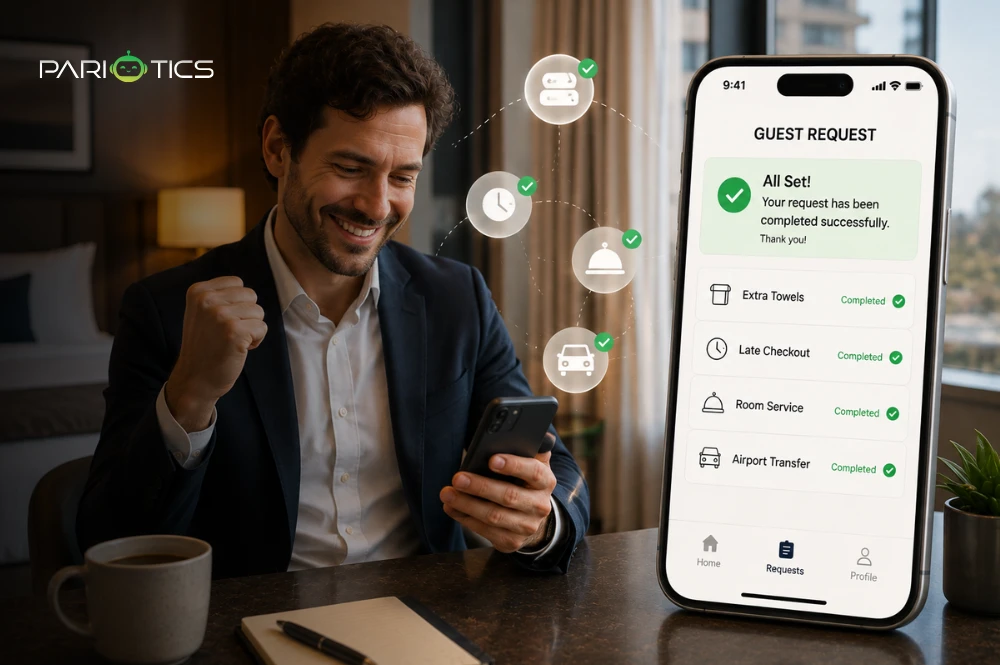
A request with a timestamp is a request that can be measured against a standard. Say your standard is towels within 15 minutes. If the task is still open at 12 minutes, the system nudges the assignee. At 15, it flags the supervisor. The guest hasn't had to call back, and the second call, the one where they sound annoyed, never happens.
That's the whole point of tracking. Not to catch staff out, but to catch the request before it becomes a complaint.
Stage 4: Reporting
This is the stage almost nobody has today, and it's the one that changes how you manage.
When every request is on the record, you can finally answer questions like these. How long does housekeeping take on average, by floor, by shift? Which hour of the night has the most open requests and the least staff? Are Friday check-in nights consistently slower? Is one department carrying twice the load of another?
A live dashboard turns those from hunches into numbers. It also gives you something for the morning meeting that isn't "nights felt rough."
Where hotel guest communication software fits, and where it doesn't
There's a category of tools built around messaging: guests text the hotel via SMS or WhatsApp, and staff reply from a shared inbox. It's a real step up from phone-only.
But messaging alone tends to move the problem rather than solve it. The request now lives in a chat thread instead of a radio call. It still needs a human to read it, understand it, and turn it into a task for the right department. At 1 a.m., with two people on the desk and a late check-in at the counter, that translation step is where the request stalls.
The distinction to look for is whether the tool creates a task or just a conversation. A hotel guest communication software product that ends in an inbox is a channel. A hotel guest request management software product that ends in an assigned, timestamped task is an operations tool. You can have both, but the second one is what fixes the follow-through.
Why voice, in the room, changes the intake numbers
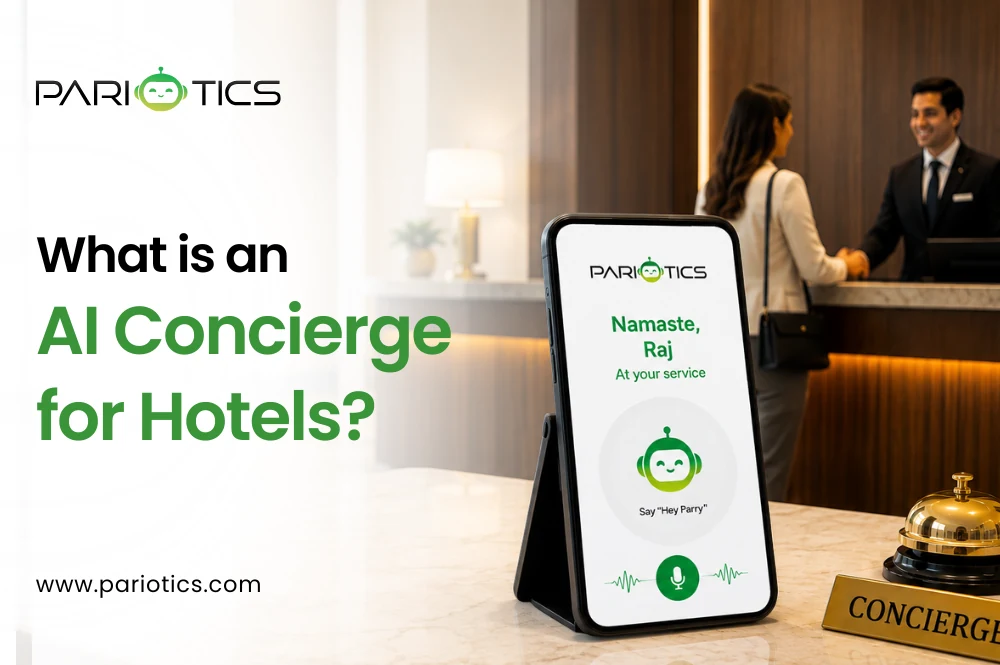
We'll be direct about our own bias here. Pariotics is an in-room AI concierge for guest requests, and we chose voice and touch in the room over an app for a reason.
Intake volume. Guests ask for more when asking is effortless. Speaking to the room, with no app, no dialing and no wake-word, is about as effortless as it gets. That includes the requests you currently lose entirely.
Language. A guest who won't call the desk in a second language will happily speak to a device that understands them in their own. Multilingual intake isn't a nice-to-have in a property with international guests. It's how you find out what half your guests actually want.
Accuracy. A spoken request that's confirmed on screen and written into a task doesn't get mis-heard, mis-remembered or mis-relayed.
Timing. The request happens where and when the guest thinks of it: in the room, often at night. That's also when your desk is thinnest, and when the phone is the least reliable path.
None of this replaces the human who delivers the towels. It just means the human gets a clear, timestamped task instead of a maybe.
What to look for in hotel guest request automation
You might be looking at a hotel guest services app, a hotel housekeeping request app, a hotel room service ordering app or a full platform. Either way, these are the questions worth asking.
- Does it capture requests from guests who won't download anything? If the answer is "they scan a QR code," ask what your adoption rate is on QR codes today. Be honest with yourself.
- Does it route to a person, not an inbox? Ask to see what a housekeeper actually receives at 11 p.m. and what happens if they don't acknowledge it.
- Can you set service standards and see breaches? A 15-minute towel standard means nothing without a flag when it's missed.
- Does it work across departments? Housekeeping, room service, engineering, front desk and concierge should all be on the same system, or you've just built a new silo.
- Is there a live view for the manager on duty? Not a weekly PDF. A screen that shows what's open right now.
- Will your team actually use it? Sit a housekeeping supervisor down with the staff app for ten minutes. If they're confused, so is your rollout.
- Does it integrate with what you already have? Ask specifically about your PMS and any existing housekeeping or maintenance tools. "We can build that" is a different answer to "we already do."
A short pilot plan that respects your team
The properties that succeed with hotel guest support automation tend to start small and measure. Here's a shape that works.
Pick one floor or one wing, ideally one with a mix of guest types and a night shift you trust to give honest feedback. Run the system there for four to six weeks alongside your existing process. Don't switch anything off yet.
Track three numbers. Average time to complete a request. Repeat requests, meaning the guest asking twice. And requests captured per occupied room per night. The third one usually surprises people, because it shows how many requests were never being made at all.
Ask your team what got easier and what got harder, fix the friction, then roll out floor by floor.
Don't judge it on review scores in week one. Those move over months. Repeat requests and completion times move in weeks, and those are the leading indicators.
Where Pariotics fits
We built Pariotics because we kept meeting owners with beautiful properties, hard-working teams, and requests that still died between shifts. Guests speak to the room, or tap the screen, in more than 20 languages. No app, no wake-word, no phone menu. Every request becomes a live, tracked task routed to the right department, with escalation if it stalls. A dashboard shows management the whole picture as it happens.
It's practical AI, built for hotel operations. Voice that Serves!
We're currently opening conversations with a first group of hotel partners ahead of public launch. If your night desk still runs on paper and memory, we'd like to show you what a month of requests looks like on the record.
Start automating
Book a demo or request a consultation to see how hotel guest request automation would work in your rooms.
Book a demo
Frequently asked questions
Isn't this just a ticketing system for hotels?
Partly, yes, and that's not a bad thing. The difference is the intake side. A ticketing system still needs someone to create the ticket. In-room voice and touch intake means the guest creates it, in their own words and language, without your desk in the middle.
Will guests find a device in the room intrusive?
A device that sits quietly until spoken to, with no wake-word or account, tends to feel like part of the room rather than a gadget. Clear guidance on data handling helps, and any vendor should be able to explain theirs plainly.
Our housekeeping team isn't very technical. Will they cope?
They should never have to be. If the staff side is more complicated than "here's a task, tap when done," the product isn't ready for a real hotel floor. Test it with your team before you commit.
We're a small independent property. Is this overkill?
Small properties often feel the problem hardest, because a night desk of one or two people takes every call. Request automation gives that team back its hands. The right system scales down as well as up.
How is this different from the AI chatbots we've seen for hotels?
Most hotel chatbots answer questions before arrival. Hotel guest request automation is about what happens during the stay: capturing, routing, tracking and reporting the requests that decide whether the guest comes back.
What should we measure to know it's working?
Time to complete a request, number of repeat requests, and requests captured per occupied room. If the first two go down and the third goes up, the system is doing its job.